|
The
Louvre Museum IV
Article written by Rick Archer,
May 2007
|
|
|
|
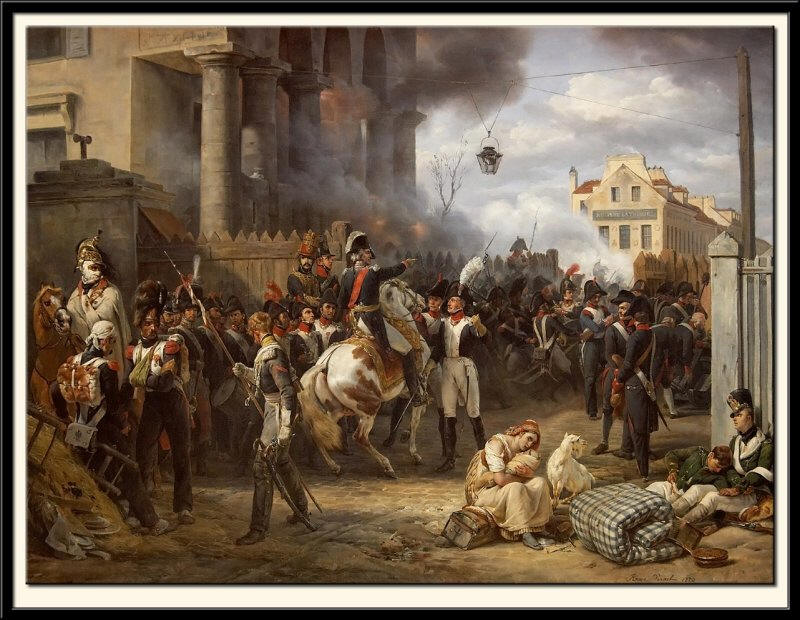 |
019.
The Gate
at Clichy
Horace Vernet
(1789-1863) c. 1820 (Louvre, Paris)
Title of picture
contributed by Anna Anderson, February 2011
|
FURTHER HISTORY OF THE
LOUVRE
The Palace
The first Louvre was a fortress built at the beginning of
the 13th century by Philip II Augustus to defend the Seine
below Paris against the Normans and English. It consisted of
a thick cylindrical donjon (dungeon) surrounded by towered
walls. This château, enlarged and embellished by Charles V
in the 14th century, was sacrificed in the 16th century at
the end of the reign of Francis I in order to make room for
a new Renaissance structure of the same size. Only the west
wing and part of the south wing of the projected palace,
conceived by the architect Pierre Lescot and decorated with
sculptures by Jean Goujon, were finished.
In 1564 Catherine de Médicis had her architect, Philibert
Delorme, build a little château in a neighboring field to
the west called the Tuileries. It was then decided to create
a grandiose royal residence by joining the Louvre and the
Palais des Tuileries by a series of buildings. The most
important is the Grande Galerie built along the Seine in the
reign of Henry IV.
|
|
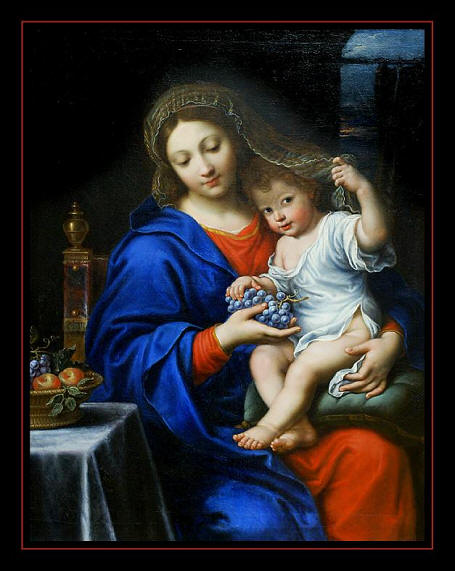 |
020. The Virgin Of
The Grapes, (La Vierge De La Grappe)
Pierre Mignard I 1612-1695, Oil On
Canvas, French Musee Du Louvre, Paris Stock Photo Image
Title of picture
contributed by Anna Anderson, February 2011
|
In the 17th century Louis XIII and his minister Richelieu
extended Lescot's west wing northward by adding the
majestically domed Pavillon de l'Horloge (clock pavillion)
by Jacques Lemercier and recreating Lescot's building beyond
it. Under Louis XIV and his minister Colbert, the Cour
Carrée, a great square court, was constructed by Louis Le
Vau. The east façade of the east wing was later given a
classical colonnade by Le Vau and Claude Perrault. The royal
apartments were sumptuously decorated by Charles Le Brun and
others, as the Galerie d'Apollon still bears witness. The
Louvre was abandoned as a royal residence when Louis XIV
moved the court to Versailles in 1682.
After the Revolution of 1789, Napoleon I, later kings, and
Napoleon III lived in the Tuileries. The Louvre was used for
offices and a museum. Along the Rue de Rivoli, Napoleon I
began a wing parallel to that of Henry IV along the Seine.
Napoleon III finished the wing, thus closing the great
quadrilateral.
A few years later, during the uprising of the Paris Commune
in 1871, the Tuileries was burned.
Paradoxically, the
disappearance of the Tuileries, which had originally brought
about the extension of the Louvre, opened the admirable
perspective that now stretches from the Arc du Carrousel
west through the Tuileries Gardens and the Place de la
Concorde to the Place Charles de Gaulle.
|
|
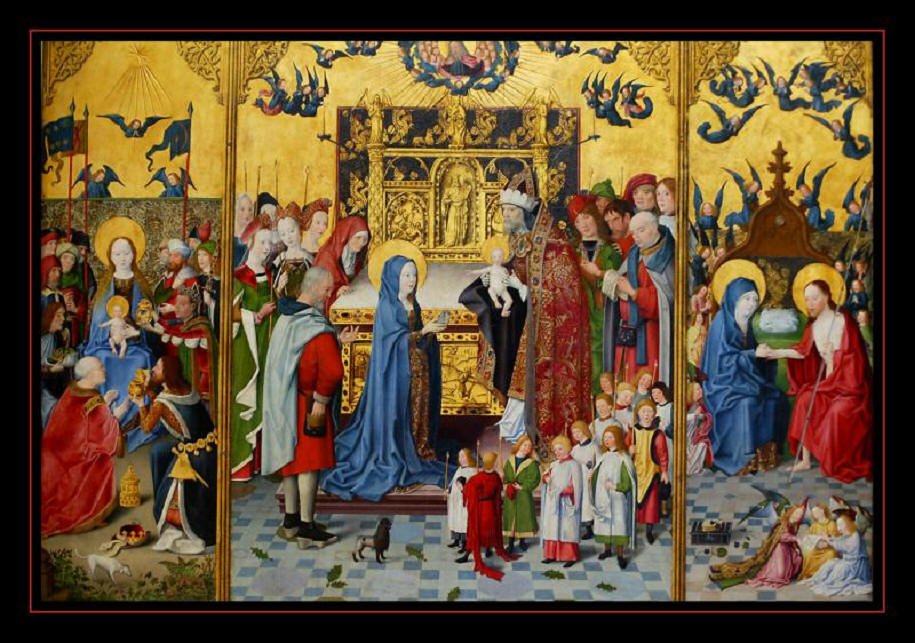 |
021. Does anyone
know the name of the painting above?
|
In the late 1980s the Louvre embarked upon an aggressive
program of renovation and expansion. When the first plans by
the Chinese-American architect Ieoh Ming Pei were unveiled
in 1984, they included a glass pyramid in the central
courtyard that would serve as the museum's main entrance.
Despite drawing protests before the fact, since its opening
in 1989 the glass Pyramid has proven remarkably effective in
accommodating the large numbers of visitors, and has even
become a relatively beloved landmark of the city.
In
November 1993, to mark its 200th anniversary, the museum
unveiled the Richelieu wing in the quarters that had been
vacated, grudgingly, by the Ministry of Finance in 1989.
This expansion, which completed the museum's occupancy of
the palace complex, added 230,000 square feet (21,390 sq
meters) to the existing 325,000 square feet (30,225 sq
meters) of exhibition space, and allowed it to put an
additional 12,000 works of art on display in 165 new rooms.
|
|
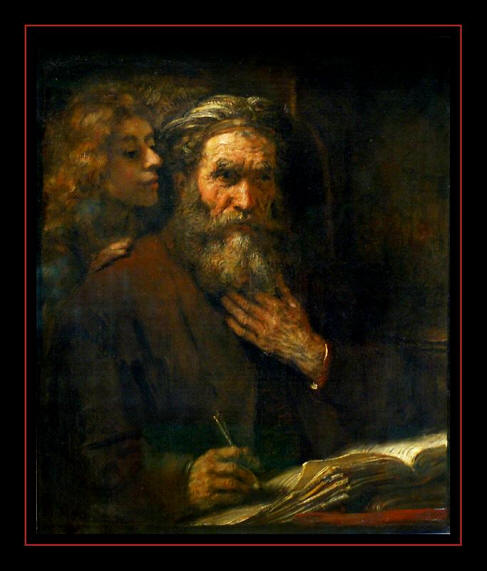 |
022.
St.Matthew
with
the Angel
-
Rembrandt Van Rijn (1661. Oil on canvas. Louvre,
Paris, France)
This Title was contributed by
Rebecca.
Rebecca's
Words: As soon as I saw this I knew it was a
Rembrandt. I had to poke around to find the name though -
St.Matthew
with
the Angel
(1661.
Oil on canvas. Louvre, Paris, France). Title
confirmed on Louvre Museum web site.
Background on this painting:
Matthew's name comes from the Hebrew Mattihah,
which means "Gift of God".
Known as Levi to Mark and Luke, Matthew worked as a tax
collector for the Romans. Therefore, Matthew was disliked by
the people. He was called by Jesus as he himself states in
his writings. He wrote the Book of Matthew which centers in
the figure of Christ and the behavior one should have if he
wanted to be a disciple. It is believed that he was martyred
in Ethiopia, executed near an altar for opposing the
marriage of the daughter of the King of Egypt.
He is usually represented in art writing the Gospel,
inspired by an angel. As an apostle his attributes are a
book, pen and a halberd, symbol of his martyrdom. He is
patron saint of Bankers and Bank employees, accountants, tax
collectors and other financial related jobs.
|
More about the
Louvre Museum
In 1793, during the Revolution, the first state
museum was opened in the Louvre, consisting of the former
royal collections of painting and sculpture. It was enriched
temporarily by loot from the Napoleonic wars and then
permanently by purchases and gifts, including archaeological
finds. More and more specialized divisions were created.
The present Louvre departments include Oriental (ancient
Mesopotamian) antiquities; Egyptian antiquities; Greek and
Roman antiquities; sculpture from the Middle Ages to modern
times; furniture and objets d'art; and paintings
representing all the European schools. A section of the
museum is devoted to Islamic art.
Universally famous ancient works of art in the Louvre
include a statuette of the Sumerian ruler Gudea, a stele
bearing Hammurabi's code, an Egyptian painted stone statue
of a scribe sitting cross-legged, the Venus de Milo, and the
Victory of Samothrace. Among outstanding later works are two
marble Slaves by Michelangelo, the treasure of the abbey of
St. Denis, and the French crown diamonds. Important
paintings include the Pietà of Avignon, Leonardo da Vinci's
Mona Lisa, Veronese's immense Wedding at Cana (which was
badly damaged in 1992 while being installed in the newly
renovated galleries), and Watteau's Embarkation for Cythera.
The school of the Louvre trains curators in history of art
and archaeology. Special exhibits are indicated in the Revue
du Louvre.
|
|
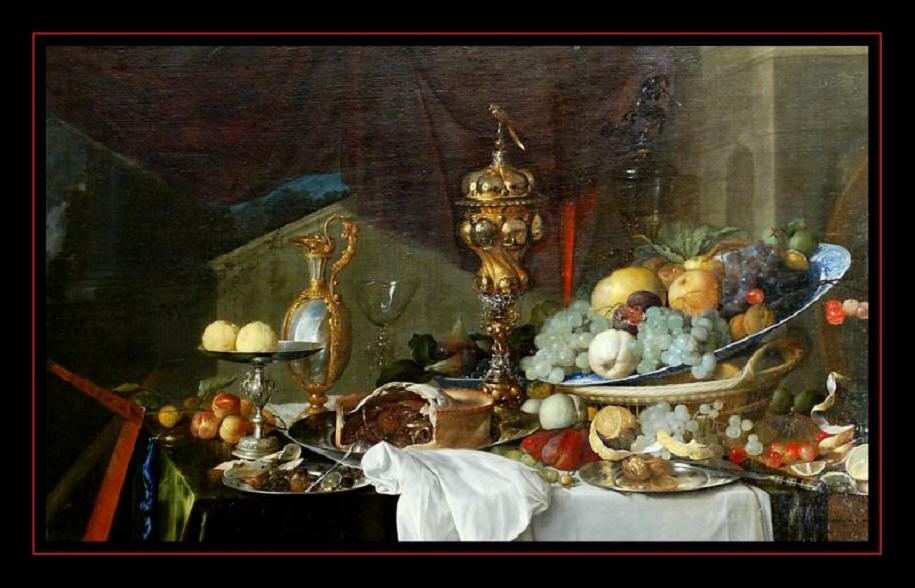 |
023. A Table of Desserts
(1640) Jan Davidsz de Heem
(This title was contributed by Rebecca)
title confirmed on
Louvre Museum web site
|
Archaeological Discoveries
Traces of the medieval fortress from which the
present day palace originates have been uncovered.
Restoration work on the Cour Carrée and the excavation
required for construction of the pyramid and the Carrousel
area enabled archeological digs to be undertaken, and for
the various phases of occupation of the palace and its
quarters to be seen.
The architectural structures of the basement will henceforth
be included in the visit tours. Thus, it is possible to walk
along the moats of the medieval fortress under the Cour
Carrée, to pass around the base of the dungeon to get to the
Salle Saint-Louis (13th century), or — when going to the
underground carpark — to walk along the so-called Charles V
Moats.
Amongst the items discovered during these digs, one of the
most remarkable is a parade helmet belonging to Charles VI,
which was reconstituted from the one hundred and sixty-nine
fragments which were found scattered about. It is on display
in the Salle Saint-Louis.
|
|
 |
024.
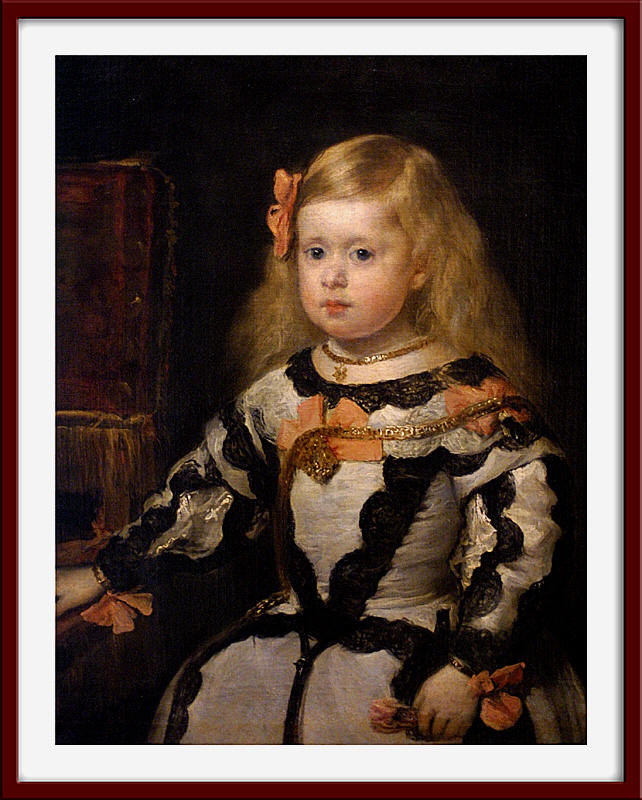
Infanta Margarita by
Diego Rodríguez de Silva y Velázquez
(Title contributed by Jan Davis) Rick Archer's Note:
I confirmed this title was correct, but could not find it
listed in the Louvre Museum web site.
|
|
 |
025.
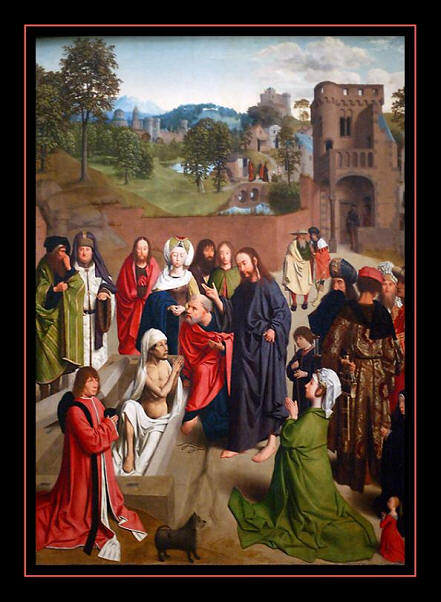
The Raising of
Lazarus 1480
Painting by Geertgen Tot Sint Jans
Title of picture
contributed by Anna Anderson, February 2011
|
|
 |
026.
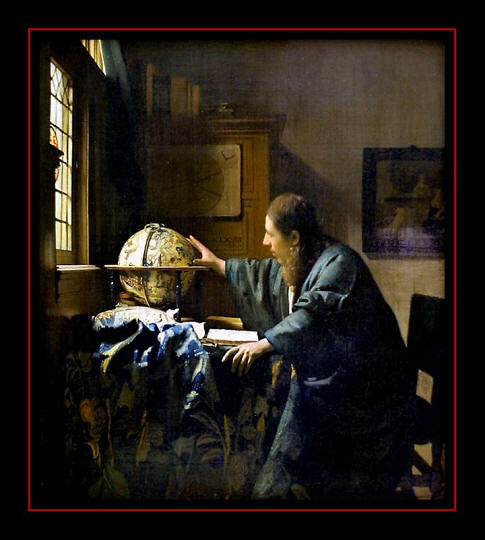
The
Astronomer,
1668, Johannes Vermeer (Title
contributed by Olga Milner)
|
|
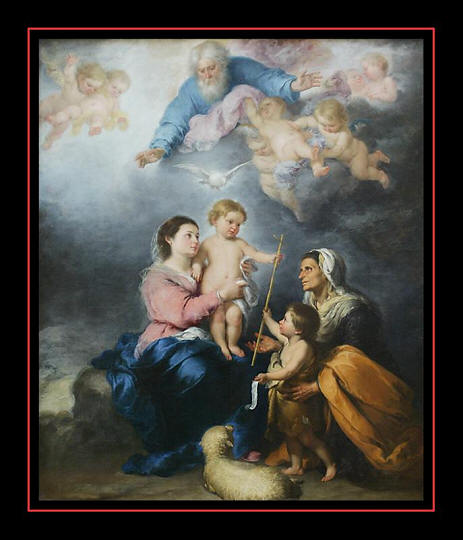 |
027.
The Holy Family
Bartolomé Estebán Murillo
Seville, 1618-1682
1665-1670Title of picture
contributed by Anna Anderson, February 2011
|
|
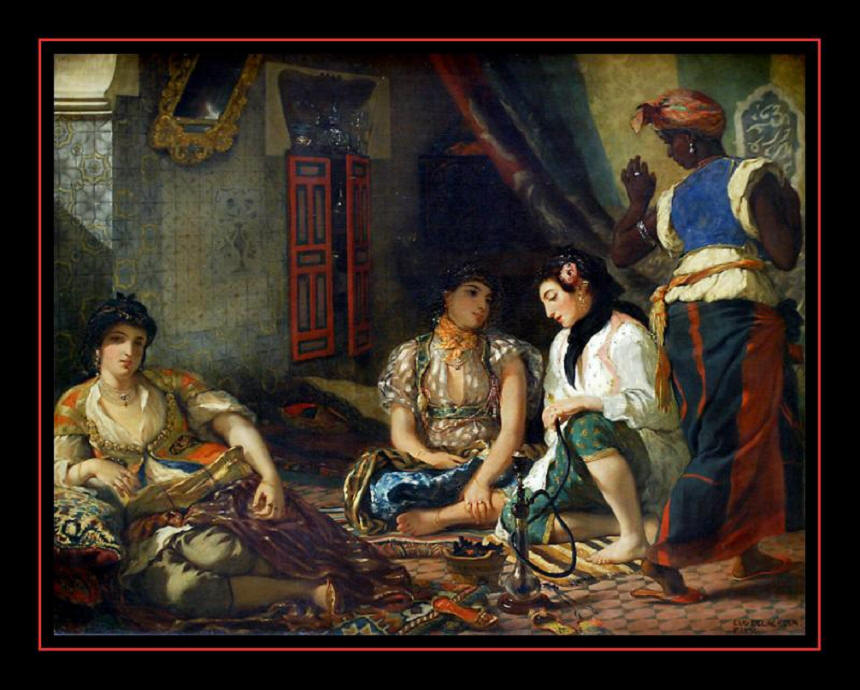 |
028.
Women of
Algiers in Their Apartment, 1834, Eugene
Delacroix
(Title contributed by Olga Milner)
|
Next Page:
Louvre V
|
|