|
BROTHER AND
SISTER
CHAPTER NINE:
MASTER
STROKE
Written by
Rick Archer
|
|
how George
Mitchell brought the cruise INDUSTRY to Galveston
|
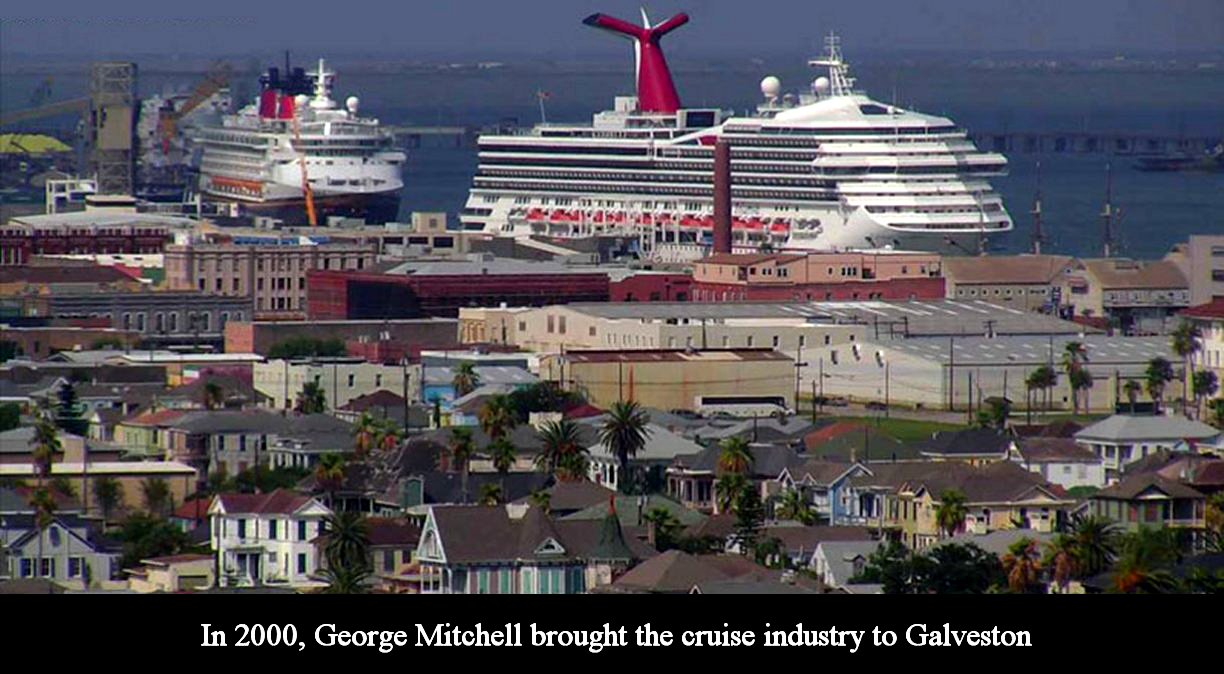
Once upon a time,
Galveston was the mightiest port in the entire
Caribbean. Then came the Great Storm in 1900. Then came
the Houston Ship Channel 1915. Eclipsed in the shadow of a
mighty city, for 100 years
Galveston's value as a deepwater port remained dormant. Things would have stayed that way if not for the
extraordinary effort of one man.
|
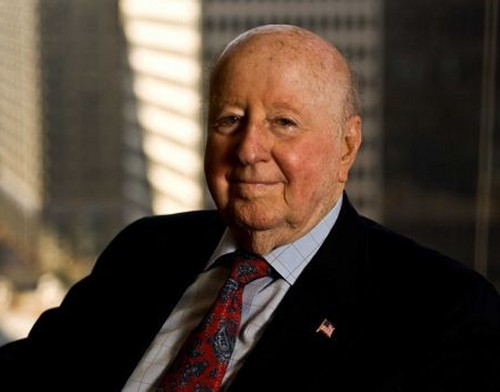
In the early 1980s, George Mitchell envisioned Galveston as a
port for cruise
ships.
For several years
Mitchell pursued this goal
only to be met with obstacles, apathy and lack of
cooperation. He could not get anyone to listen. Carnival Cruise Line
was not interested and Galveston's Port Authority had given
up asking them to reconsider. Although he was very
frustrated, Mitchell was undaunted in his vision that the cruise industry would do well in Galveston.
Taking matters into his own hands, he bypassed the
city managers and approached Carnival on his own.
According to
Douglas Matthews, former city manager of Galveston, over
the years
George Mitchell had contributed millions of dollars into his
many projects on Galveston Island. One would think this
generosity
would buy Mitchell a million dollars worth of credibility, but apparently not. Matthews recalled how
Mitchell fought the Galveston City Council and the Wharves Board over his request to build a cruise ship terminal
plus a
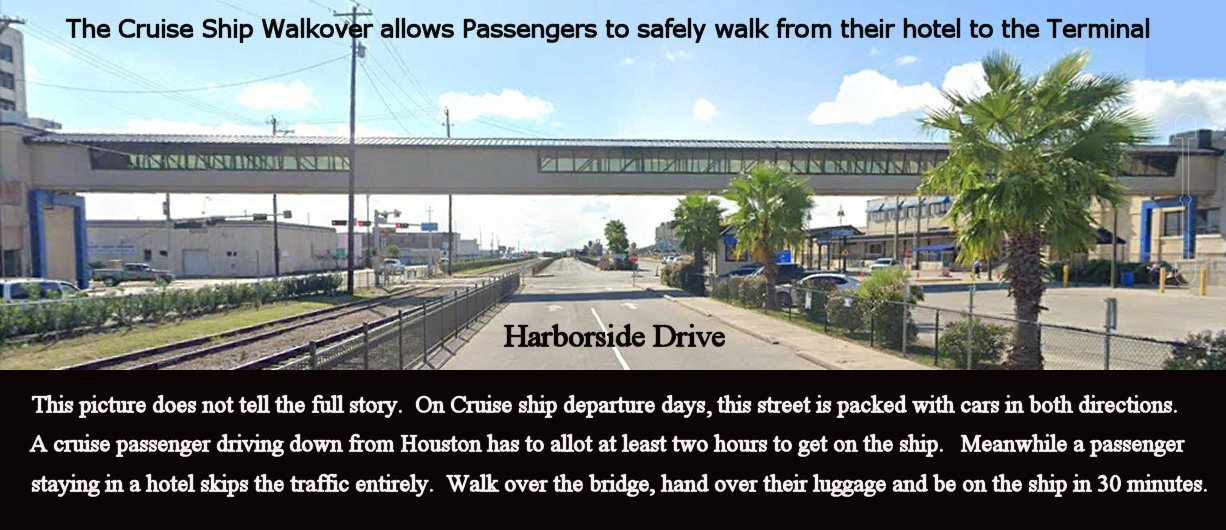
$750,000 cruise ship walkover in the late 1980s. The walkover
would connect nearby hotels to the cruise ship terminal.
By crossing Harborside, the busy street below, hotel guests
could dodge traffic while wheeling their luggage
to the ship. Mitchell thought the walkover was
important, but no one agreed.
So what was the
problem? Here is how Matthews explained it.
|
 |
"The critics
just couldn't see it. They labeled
George's walkover idea as the 'Walkway to Nowhere.'
To them, it was a pie in the sky daydream. Thank
goodness George had the
vision to persist. In defense of the obstinate
officials, this cruise project was a huge, costly gamble. Galveston would
need to build an expensive
cruise terminal without any guarantee the cruise ships
would come. Given that the city's economy had been in
dry docks ever since the Texas Rangers ran Sam Maceo out
of town, no city official had the
courage to do it. It was beyond their imagination, far too
risky. For one thing, no one was banging on the doors
begging to take a Galveston cruise trip. They
interpreted this to mean there was no cruise market in Texas. So the Port Authority officials
said no. George blew his top. Fortunately he had the sense to wait till we were alone to explode.
Speaking out
of earshot, George said, 'Damn it, Doug, if they're not
going to do it, then I'm going to do it myself!"
|
400
YARDS:
THE 'walkway to nowhere' controversy
|
Rick Archer's
Note:
George Mitchell began
his pursuit of the cruise industry in 1985.
He made his big pitch in 1990, got final
approval in 1992, then began an 8-year
promotional campaign. Finally the big day arrived. On September 30,
2000, a Carnival
cruise ship named
Celebration made
her inaugural voyage out of
Galveston. The
project was an instant success. Texans
flocked to Galveston in droves.
In
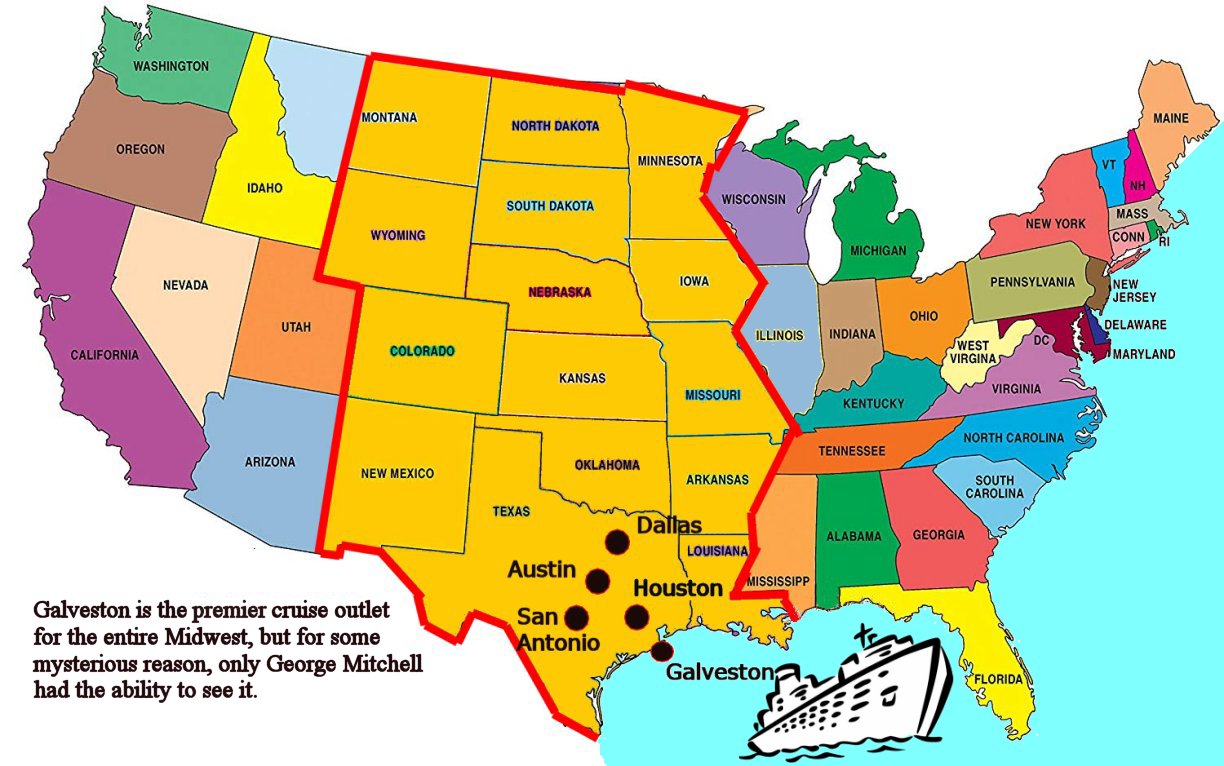
hindsight, it all seems so obvious. Galveston
was the closest seaport to Texas,
Oklahoma, Colorado, Kansas, Nebraska, New
Mexico and the entire Midwest.
Practically
overnight Galveston became the fourth busiest cruise
port in the country. This happened because
George
Mitchell was able to see things that other people
missed.
Galveston
was back on the world map and its hotel industry
was back in business.
During George Mitchell's
quest, he eventually got his way regarding the
controversial 'Walking to Nowhere'. On
a personal note,
I have taken 20 cruise
trips that departed from Galveston. Due to my
keen interest in George Mitchell, I decided to
investigate why the 'Cruise Ship Walkover'
was so important to him.
|
To me,
the most interesting part of the Galveston
cruise ship story is
how hard Mr. Mitchell had to work to make it
happen. According to Doug Matthews,
George Mitchell nearly lost his mind due to
his impatience with the Galveston Port
Authority over their refusal to approve his
$750,000 "Walkway to Nowhere". According to
Matthews, former city manager, over
the years
George Mitchell had grown sick of beating his head against
the wall with the Galveston City Council and Wharves Board.
The most bitter fight took place in the late 1980s over his request to build a
$750,000 cruise ship "Walkover".
Curious
to understand why this Walkway was so important to Mr.
Mitchell, I searched the Internet in vain for an
explanation. Frustrated, I decided to speculate on
my own.
I decided it all boiled down to 400
yards. This was the distance it took for a tourist to walk from
the Hotel Galvez to Sam Maceo's Balinese Room. I
imagine this distance held powerful symbolism in George
Mitchell's mind.
|
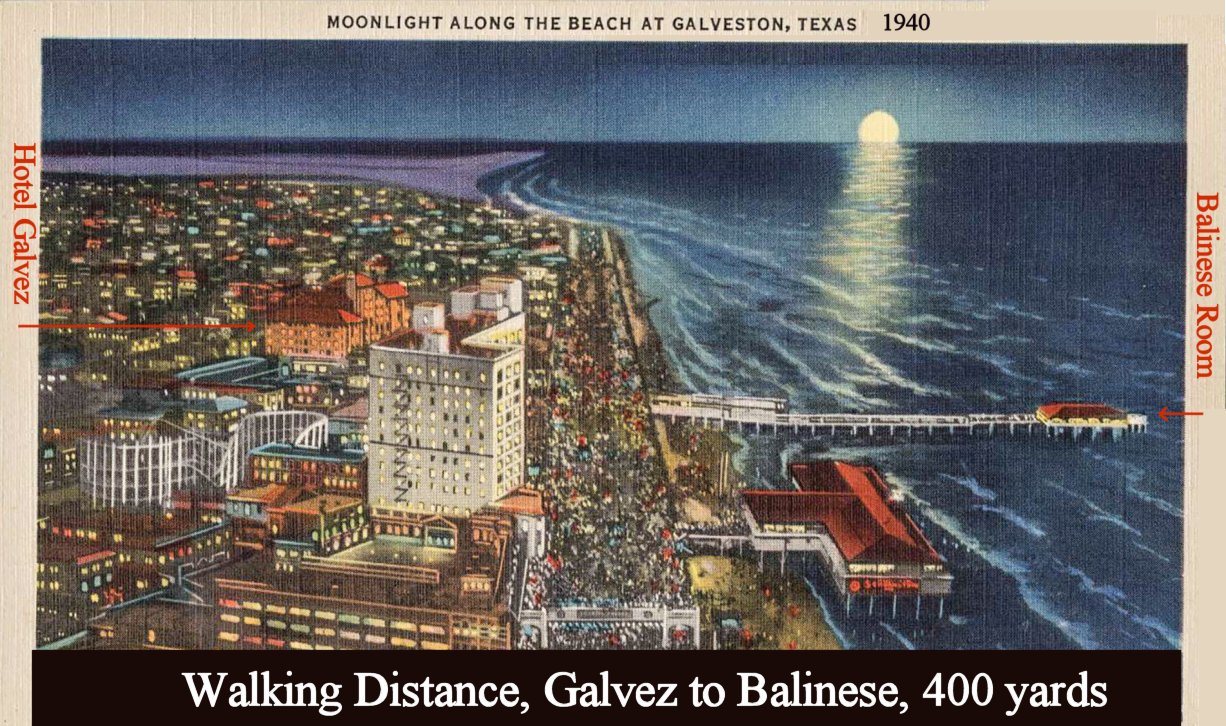
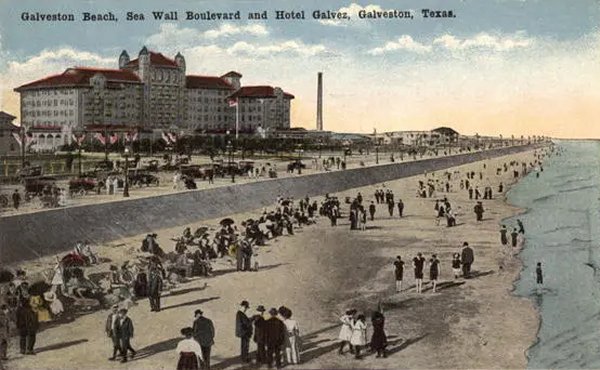
Following the Great Storm of 1900, Galveston had no choice
but to finally begin the long-delayed seawall project.
Watching helplessly as Houston ripped the shipping industry
from its grasp, Galveston's leaders decided to use
their beautiful beach to attract tourism.
Crossing their fingers, they approved construction of the
Hotel Galvez. It was completed in 1911.
Unfortunately the gamble failed. Not entirely, of course, but
there was no compelling reason to fill the hotel. Fortunately, the arrival of
Prohibition and Sam Maceo during the Roaring Twenties solved the
problem. For the next twenty years, Maceo's casinos helped fill the hotel to
capacity.
Born in 1919, George Mitchell
grew up during Galveston's resurgence. His
high school years would have coincided with Sam Maceo's master move, the
opening of the fabulous Balinese Room across the street from the
Hotel Galvez. As he fished in Galveston Bay after school, no doubt he witnessed the steady stream of
customers as they walked 400 yards to Maceo's casino.
A very
important thing happened in
Mitchell's junior year of college. Dead broke,
Mitchell was convinced he had no choice but to drop
out of Texas A&M with his education only half-complete. That
is when Sam Maceo mysteriously stepped forward with his shocking
offer to pay Mitchell's remaining tuition.
Incredibly relieved that this powerful man was willing to help an
obscure
college kid he barely knew, Mitchell was overwhelmed with gratitude. I am
firmly convinced Mitchell's gratitude became the inspiration that led
him
to put Galveston on his shoulders 40 years
later when the city was on the ropes.
Galveston badly needed a new source of revenue. Mitchell
wanted to use the cruise industry as a way to turn the
island into a tourist destination.
Getting the
cruise ships was a huge step, but Mitchell
understood that the hotels were just as important.
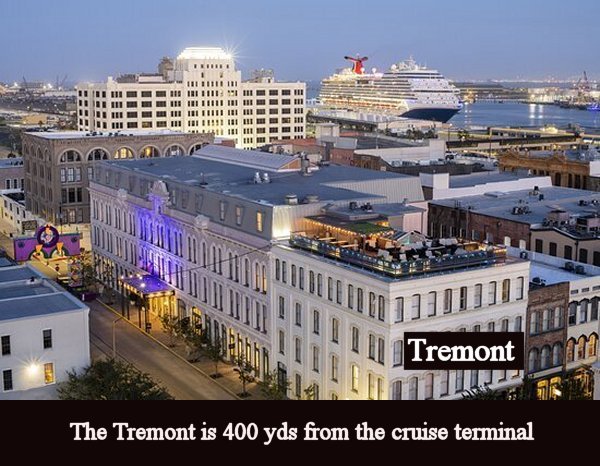
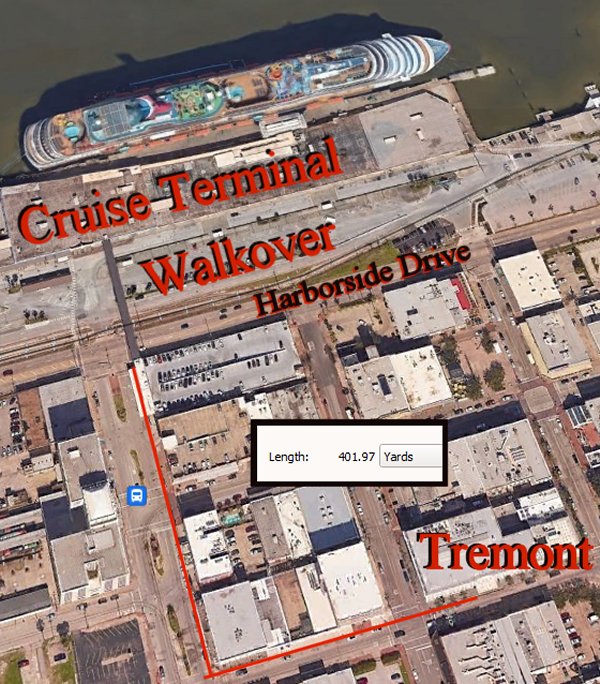
Recalling the link between the Balinese Room and the Hotel Galvez,
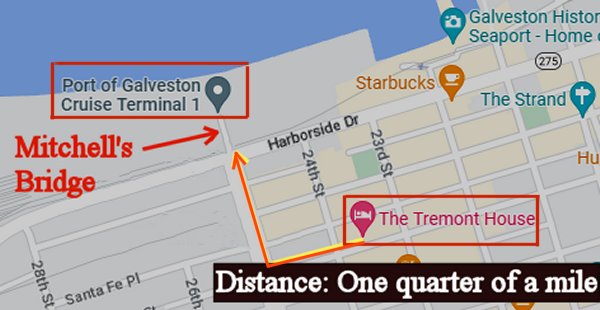
Mitchell decided to take a little walk from the Tremont House Hotel he
had just purchased over to
the
proposed cruise terminal location. Just as he thought.
400
yards. Well aware the cruise ships would be just as effective
at drawing tourists to the shores of Galveston as the Balinese Room, Mitchell
authorized Tremont's $20 million
renovation. This was a huge gamble. Why?
Because there was no assurance the cruise industry could be persuaded to
come.
With this in mind, Mitchell's next step was to contact Carnival while
simultaneously seeking city approval for the cruise terminal and
Walkover. To his dismay, neither Carnival nor the obstinate city
Wharves Board showed the slightest bit of interest. Mitchell was
fit to be tied. The hotels
were the perfect way to pump tourist dollars into the economy, but there
was a major problem.
Mitchell feared most
Texans would bypass the hotels as an unnecessary added cost.
Houston was a lost cause. Why bother with a hotel?
With Galveston in their backyard, Houstonians could take a
leisurely hour's drive to the ship, park their car, and take
a shuttle to the terminal. For that matter, if
someone lived in Dallas, San Antonio, or Austin, they
too could skip the hotel. They could
get up early,
drive four or five hours, then board the ship in the
late afternoon.
If all a passenger did was drop his car off in a parking
lot, that would not do much to improve the Galveston economy.
How could Mitchell persuade
people to come a day early, maybe even two days early and
stay in a hotel prior to the trip?
If Mitchell
could find a REASON to fill the hotels, that would be the
finishing touch. Mitchell
had
one advantage. Other than people living in the Houston area, most Texans were
looking at a long drive.
Noting the drive from Dallas was five hours, a
hotel offered tourists a chance to rest up plus an
evening to enjoy
the nearby beach and Galveston's fine seafood restaurants.
That was a good reason to consider coming in a day early.
However,
was
there some way Mitchell could make staying at a hotel even more valuable? Yes! There was a looming
headache known as Harborside Drive.
Long before anyone else, George
Mitchell foresaw
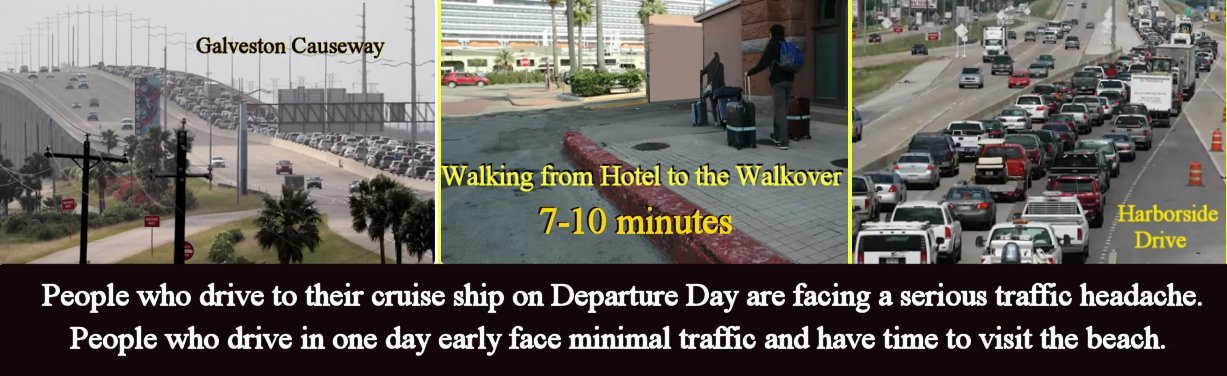
Harborside Drive as a serious obstacle on Departure Day.
Let's say a cruise ship has 2,000 to 4,000 passengers. That adds
up to thousands of cars. Mitchell foresaw that
Harborside would be packed with wall-to-wall
cars
on
Departure Day and again on Return Day.
Based on personal experience, I can
confirm that Mitchell's prediction was correct.
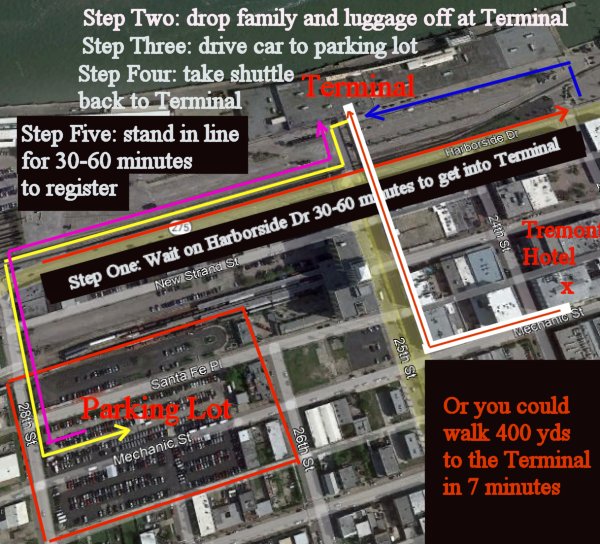
First you sit in traffic on
Harborside for 30-60 minutes in an endless wait to
drop family and luggage off at the terminal. Then
someone has to drive the car to the parking lot a mile
away. Then the driver has to wait for a shuttle bus to return
him to the terminal. Once reunited with family and
friends, now comes another 30-45 minute wait in the
Registration line before being allowed on the ship.
Since there is no way to widen Harborside Drive and no
way to streamline the process, boarding the ship
is often a two-hour ordeal IN ADDITION TO THE DRIVE TIME
DOWN TO GALVESTON.
Although Harborside Drive became an enduring curse to passengers,
it was a blessing to George Mitchell.
"400 Yards" was his ace in the hole.
As opposed to the two-hour hassle of fighting traffic,
Mitchell
could promise
guests who stayed at Tremont or other nearby hotels such as Harbor House that they
could get to the Cruise Terminal in 7 minutes.
Tremont House is so close to the terminal,
people can actually walk
rather than drive. A 7 minute walk, 10 minutes tops.
What could be easier? Walking to their destination would allow guests to leave their cars safe
in the hotel parking lot during their trip. "Walking" would save
time plus
two taxi fares: one to
the ship and one back to the hotel at trip's end. Even better, by
leaving the hotel early, hotel guests would be first in line to register.
That would give them the rest of the day to relax on the
ship. In a sense, staying at the hotel would add an extra day
of comfort lounging
on the ship.
However, for this to
work, passengers would need to cross busy,
traffic-clogged Harborside
Drive. This would not
work for families with kids. Mitchell had a
solution: Build a Walkover.
Mitchell suggested
building a bridge to connect the nearby hotels to the cruise ship and
let people walk 400 yards to the ship. Since modern
luggage is on wheels, let the kids tote their own suitcase.
What a great sales pitch! This
would give people a valid reason to drive in early as opposed to
arriving on Departure Day.
Arrive a day early, enjoy the city,
and get
a good night's sleep. Best of all, skip the hassle of traffic in the morning.
This solution made a world of sense. However, it also
had a hefty price tag. $750,000.
|

 |
Unfortunately the
Port authorities refused to approve the overhead walkway. Too
expensive. Nor was it necessary. Just hire a couple of cops
to stop traffic every time someone wants to cross the street (who cares
if this solution makes the traffic problem even worse?)
The critics labeled
George's bridge idea as the 'Walkway to Nowhere.' They
could not see this bridge as anything other than a huge waste of
money. In defense of the officials, this project was a very risky,
very costly
gamble. Mitchell tried to get them to see the
logic of the move, but he had one major vulnerability. What if
they build this bridge and the cruise ships still refuse to come?
Ultimately Mitchell realized the only way to
make his plan work was to first convince Carnival to commit. He could then use their
commitment as a way to persuade the Port Authority to
build the Walkway and Terminal.
In the end, once Mitchell got Carnival to commit, he
finally got his Walkover approved. The years
since have proven that George Mitchell's foresight was correct from
the start. Once people caught on to the advantage of
arriving a day or two early, Galveston's hotels and
restaurants were blessed with countless customers.
The economy boomed.
.............................
However, this
success story raises a question. How
did George Mitchell persuade the cruise
industry to come to Galveston?
|
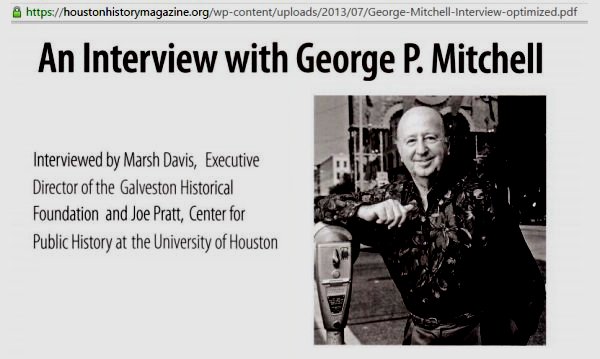
AN INTERVIEW
WITH GEORGE MITCHELL
|
Rick Archer's Note: This priceless 2013 interview with George Mitchell explains
what happened next.
|
 |
George Mitchell: "We worked hard to get the cruise ships down here
to Galveston. Oh,
yes, indeed we did.
I had a friend tell me:
"George, how in the hell did you get the
cruise ships down here? What a great move! We like visiting
Galveston. Hey, buddy, you're costing me money. My wife says we need to come down and buy some
real estate as well."
Sure enough, bringing in the cruise ships was an eye
opener. It made everybody realize something big is
going on down here. So now we're pushing to put two more
cruise ships at the Del Monte terminal. They would
have seven cruise ships in a row and you should get an
aerial
picture of that. Very impressive!
|
A lot of American cities would be jealous of
what we have here. I'm telling you,
they would be. Bringing the cruise
ships was a valuable addition to be sure.
Soon everybody's going to be saying the same
thing, "What the hell is
going on down in Galveston??"
There's an interesting story about that. I kept
asking the cruise terminal people to do something.
We had a committee,
but they weren't very strong, certainly not bold and I wasn't getting
anywhere. Every chance I got, I'd ask the Galveston Port
Authority,
"Hey, guys, you've got all this empty space down at the
docks. Why don't you
work on getting the cruise ships?"
They said, "Well, no,
George, we've tried. We don't have a chance. They don't
answer our calls, they don't give us the time of day."
|
 |
What a runaround! I got tired of listening to them. So I sent a
representative to Miami four years straight at my own
expense, five thousand dollars a pop, just to talk to the cruise
ship companies. "Hey, guys, why don't you come to Galveston?
Give it a try."
Every time
my guys did that,
Carnival would just yawn. The Port
people would hear that I struck out again and would send me a message,
"You're wasting your time, Mitchell. You're wasting your
money, you're wasting your time, you're wasting our time. Give it up.
Why don't you listen?
They won't come
here. They have said so repeatedly. There's
no market!"
No market? What kind of nonsense is
that? Has anyone looked at a
map lately? Finally I said, "Okay, give me a package to take to
the cruise people. Let me see what I can do."
So I got the Galveston port people to say,
"This is what their taxes will be; this is what this
cost
would be; this is what that cost would be."
I was
impressed. These were good terms. They were
fair. Now I had
something tangible I could put on the table.
So
this time I decided to make the pitch
myself. I
got on the plane and took
the package to the
Carnival cruise ship people over in Miami.
They were pleased. They thought the numbers looked pretty good too.
Okay, I thought, now we're getting
somewhere. They are finally starting to get interested.
Or so I thought. Next thing I
knew, the deal almost fell through.
|
As long as I live, I will never forget the
moment. I have been at this for more
years than I can count and just as I think something is
finally going to happen, a
Carnival guy begins to frown.
He shakes his head, then looks at
me.
"George, where are the
customers going to come from?"
All the others nodded. Every man in the room had
a worried
frown on their faces. With the deal hanging in
the balance, I looked at them dumbfounded.
Are these
guys
kidding with me? No! They were dead serious! They
didn't get it!! They actually didn't get it at all.
So I spoke up.
"Gentlemen,
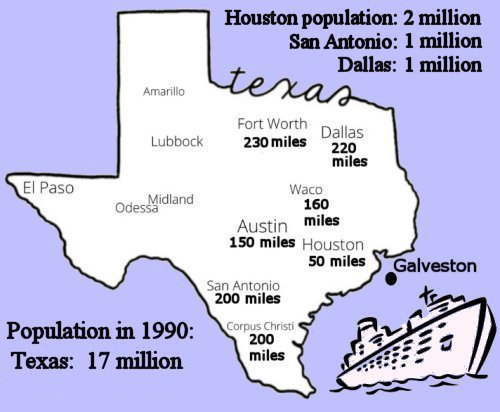
Texas is a very populous state. 17 million, 12 million
of whom live
within a 300 mile radius of Galveston. NASA is
Galveston's
next door neighbor. Houston, the 4th
largest city in America, is just over the causeway. This is an
untapped market! You men are looking at a gold mine!"
They all started to blink.
If I didn't know better, they acted like this was the first time
they had ever heard such a radical concept. The
fourth largest city, gee, what do you know
about that?
"How far away
is Houston?" they asked.
I almost laughed out
loud.
These men were college graduates, but they
acted like none of them had ever looked at a
damn map. I
was so incredulous, I couldn't help it, I raised my voice.
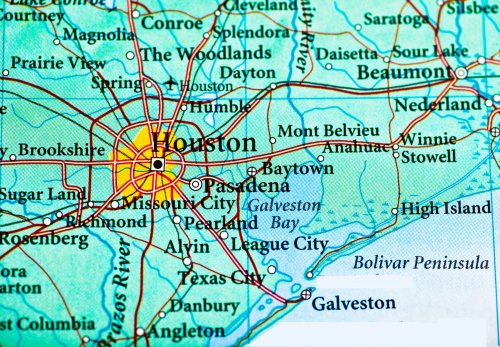
"Come on, guys,
Houston is just 50 miles away, an hour drive at most!"
An hour away?
Really?
Gosh, that's close enough for passengers to
drive down! There are two airports in
Houston. Better yet, the whole state of Texas
was within driving distance. Seriously, it took every
ounce of self-control for me to keep a
straight face.
Now they started to nod.
Hey, what do you know, this might just work!
They turned their attention back to me.
"Well,
George, we
would have to do some
serious advertising."
"Promise
me you will come to Galveston and we will help you do
the promotion for the first year. How much do you need?"
They wanted $250,000 to begin promoting the
arrival of the cruise ships to Texas. I said okay,
guys, that's a lot of money, but I will see what I can do.
So I took the deal back to the Port Authority. That was 1992.
After the Port
Authority did the final
negotiations with Carnival, the company requested $250,000 from
the private sector to pay for a portion of their first
year’s advertising budget.
So I went about raising
the money. The Moody family, the Fertitta family,
and the Park Board each contributed $50,000. That
left us $100,000 short, so I threw the additional
$100,000 into the pot. That did it. We closed the deal with
Carnival.
I was excited.
I could not believe after all that work, Carnival had
finally accepted the deal. Let's do this promotion and try it out!
Weren't they surprised!? Yes, almighty, it was a success from Day One
back in year 2000. After a year or two, statistics reported that 75
percent of the people were driving in, not flying.
These were brand new customers from within that 300 mile radius I
had spoken
of. That made all
the difference in the world to Carnival. They expanded as fast as they could.
And then the other companies smelled the
bait and they came too. Royal
Caribbean, Norwegian, Disney. But
give Carnival the credit,
Carnival was the first. Carnival got the ball
rolling."
|
 |
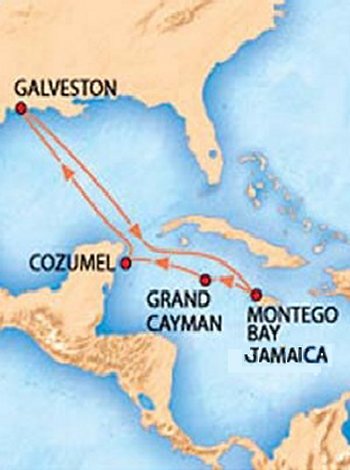
America's 4th busiest cruise port
|
 |
"But,
George, where are the customers going to come from?"
Following Carnival's successful launch in
2000, in the space of just a few years,
Galveston became America's fourth busiest
cruise
port, trailing three previously established locations in Florida.
Galveston was bigger than Boston, bigger
than New York, bigger than L.A.
Galveston had
more than just cruise ships going for it. It had Moody
Gardens, a
busy water park, and a beautiful warm-water beach
within walking distance of the hotels. Once people
discovered what a great spot Galveston was for their kids,
they had reasons to come again whether booking a cruise
or not. Overnight Galveston's tourist industry
began to compete with the popular San Antonio Riverwalk for the almighty
tourist dollar in the State of Texas.
The boost to
Galveston's economy was astronomical. With a flood of
Texans driving down to the city, many cruise passengers came
a day early, some two days early, maybe even a week early. Not only did the hotels thrive, all sorts of
tourist-related attractions popped up. With jobs
being created right and left, Tourism brought prosperity
back to Galveston for the first time since the days of Sam Maceo. In retrospect, it seems so obvious.
How could anyone have possibly overlooked the
cruise potential of Galveston?
The image of a
flabbergasted George Mitchell staring in shock at those Carnival
executives tickles me no end.
Well, duh, has anyone in Florida ever
heard of Houston? It staggers the mind
that George Mitchell had to explain Texas was the second
most populous state in the country. Not just that, Texas was an
untapped market. Why fly to Florida for a cruise when you can
drive to Galveston?? Talk about a Blind Spot. My
guess is the
Florida-based executives had been locked into the mind-set that
Florida was more than sufficient. While it was true Eastern
USA residents were used to cruising
the Eastern Caribbean, George Mitchell
suggested that mysterious body of water known as
the Gulf of Mexico had vast potential.
|
 |
Galveston is well aware of the debt it owes
to George Mitchell. They have
statues of him scattered all around the city.
In addition, they renamed the bridge that
connects mainland Texas to the island in his
honor. From my vantage point, the
Mexican city known as Cozumel should also erect a
shrine to Mitchell.
Cozumel has become one of the
the richest cities in Mexico thanks in large
part to Galveston. As many as 8 cruise
ships per day dock on its shores. I
know this for a fact; I've seen it with my
own eyes. Can you imagine 20,000
cruise passengers a day visiting with money
to spend? Cozumel is so
swamped with tourists it has built three
piers, one for Carnival, one for Royal
Caribbean, one for the other cruise
lines.
Cozumel had a clever idea. Well aware
that 80% of all cruise passengers are too
lazy to explore the island, they built giant
tourist traps to surround each pier.
These complexes are so large, they operate
like a maze. Even better, there are
virtually no Exit Signs. Unless you make a
determined effort to leave, you wander from
shop to shop without seeing an escape route.
Nobody complains. These people can buy
everything trinket imaginable within easy walking
distance of the ship. Most people buy
at least a tee-shirt, then stop for several rounds of margaritas with their friends
before returning to the ship.
The amount of money that flows into the
Cozumel economy is beyond comprehension.
And the thing to understand is that same
thing has happened to Galveston. The
same people who have made Cozumel rich have
made Galveston even richer. However,
back then no one could see it but George
Mitchell. How could the cruise
executives be so blind? They were the smartest
guys in the room, experts who theoretically had
a working grasp of geography and population
statistics. The sheer ignorance
of it all is mind-boggling.
Fortunately,
Mitchell's dogged determination won the day.
Once Mitchell did the heavy lifting, the
Galveston city
officials gave in and built the expensive port
terminal.
Galveston is now the major cruise port in the Gulf of
Mexico.
In the end, George Mitchell's vision was absolutely correct. His
determination to bring the cruise ships to
Galveston paid off handsomely.
|
|
|
|